
Computer Aided Mechanical dynAmic System Laboratory
Research at CAMAS Lab centers on the modeling, analysis, and control of dynamic systems across mechanical, electrical, hydraulic, and pneumatic domains. A key focus is on advancing the understanding of energy-domain interactions, developing unified physical modeling frameworks, and designing control architectures to effectively address complex nonlinearities and inter-domain dependencies.
The primary goal is to enhance intricate mechatronic systems through the development of advanced robotic platforms possessing high adaptability, precision, and intuitive interaction. These platforms are aimed at advancing industrial automation and optimizing manufacturing processes, ensuring robust operation in real-world environments.
![]() |
Robot Mechanism Design & Control
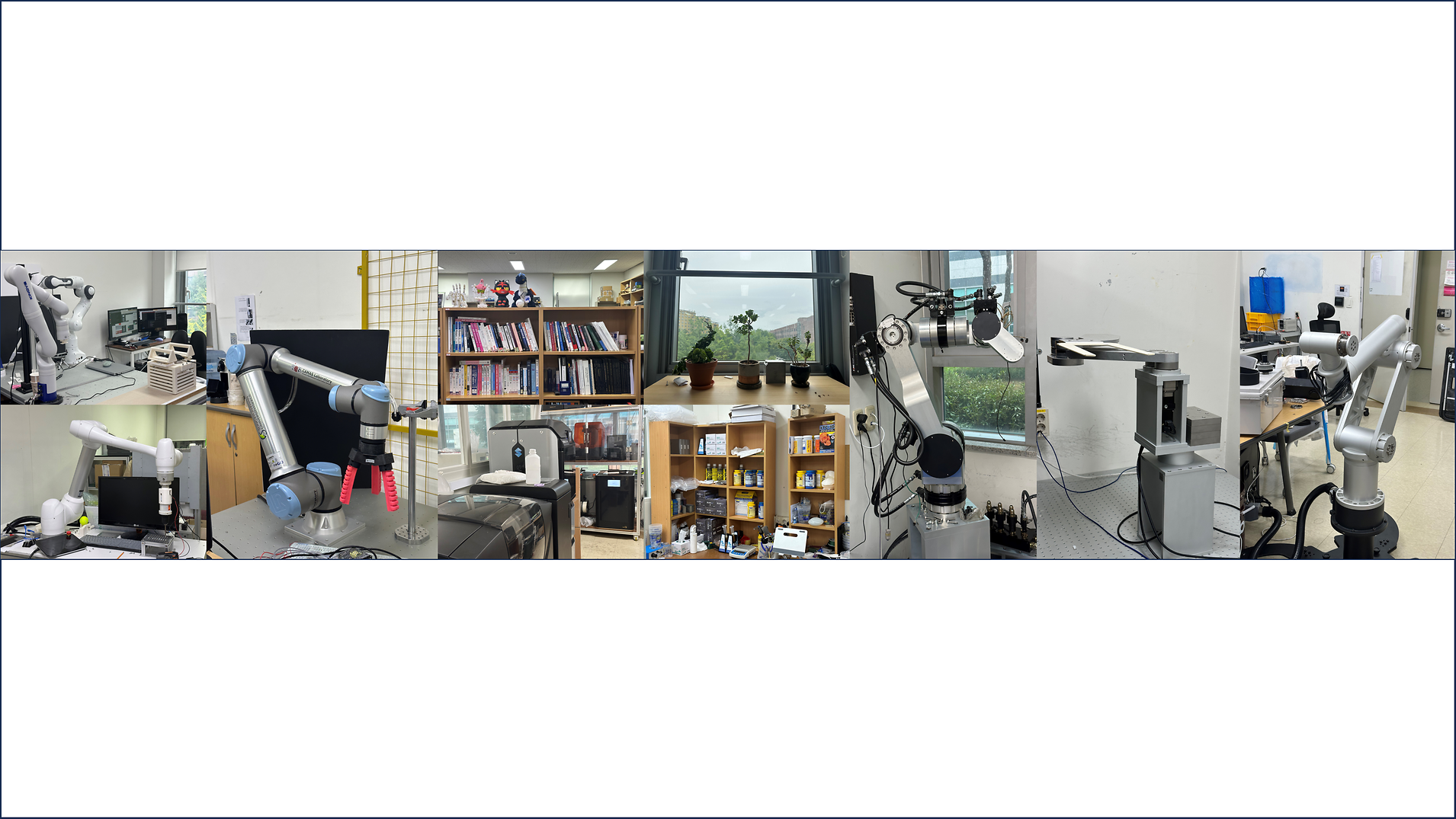
Robotic mechanism and control research at CAMAS Lab addresses the design and implementation of systems suited for collaborative, industrial, and semiconductor applications. Central topics include the development of variable stiffness mechanisms for adaptive assembly tasks, as well as motion strategies that enable responsive physical interaction with uncertain environments. Research also includes the design of soft pneumatic rotary actuators with high torque output and soft grippers that utilize particle jamming for safe human interaction. In parallel, hydraulic manipulators are being developed for cooperative manipulation of heavy payloads, alongside control methods that support intuitive human–robot collaboration. Precision control technologies are further explored for wafer-handling robots operating in cleanroom environments, where stability and throughput are critical. |
Robot/Environment Interactions
Research on robot–environment interaction at CAMAS Lab focuses on enhancing robotic performance in contact-rich tasks by developing control strategies for physical human–robot interaction, collaborative manipulation, and adaptive contact with uncertain environments. Key efforts include the development of intent estimation frameworks, where human motion is dynamically modeled and compensated in real time to enable the robot to follow user intent. Based on these estimates, unknown dynamics are addressed through input compensation to improve collaborative task performance. Learning from Demonstration (LfD) is also applied to intuitively transfer complex physical skills to robots, while leader–follower strategies are explored for cooperative manipulation of large objects using multi-robot systems. In addition, control techniques are developed to ensure robust and stable performance in tasks involving irregular surface contact, such as grinding. |
|
![]() |
Robotic Automatic Assembly
Robotic assembly research at CAMAS Lab focuses on solving diverse and complex assembly tasks by combining mechanical design with advanced control strategies to enhance assembly performance. A central topic is the integration of multi-degree-of-freedom Variable Stiffness Mechanisms (VSMs) with robots, along with the development of precision control algorithms for stiffness adaptation. By optimizing the impedance of both the robot and the VSM according to task characteristics, the system achieves flexible and stable performance across various assembly scenarios. Impedance-based control strategies enable smooth transitions between compliant exploration and firm insertion, making the system well-suited for high-precision tasks such as multi peg-in-hole insertion, electronic component fastening, and gear assembly. In addition, reinforcement learning is applied for real-time parameter adjustment, ensuring robust operation even under pose uncertainties and manufacturing tolerances. |


